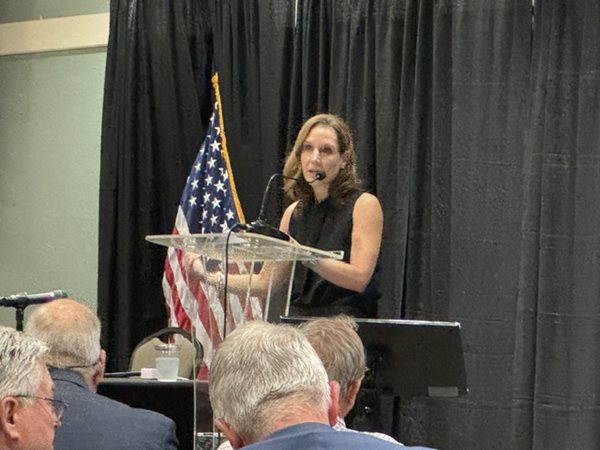
The meeting helps fulfill a requirement within state law for a community to be designated as nuclear-ready. The featured presentation was from Kara Colton of the Energy Communities Alliance, where she serves as their Director of Nuclear Energy Programs. Colton was called upon when Dr. Patrick White had to withdraw from the event. She spoke about how her organization works with communities, helping them determine if nuclear projects are right for them.
Colton said that even though they work with the Department of Energy, they are not always in favor of the projects presented. She did note that the demands for energy have ramped up with new technologies, and that is driving new discussions on nuclear. Colton said that a big advantage to becoming nuclear-ready is that it puts local government officials at the table with those from the state and federal government.
The presentation covered ground from the fuel and supply chain, through energy production, and then dealt with the waste on the back end. She noted that one fuel pellet, which is about the size of a fingernail or a pencil eraser, is the equivalent of one ton of coal, 149 gallons of oil, or 17,000 cubic feet of natural gas. The footprint for nuclear generation is also much smaller than renewable sources like wind and solar. Colton said that according to the industry, a 1,000 megawatt nuclear facility would require about one square mile, while wind would need 360 times that, and solar would need 75 times as much.
During the public comment portion of the evening, community members were given three minutes to speak, raise concerns, and ask questions. All of the comments were recorded, and answers to questions will be disseminated in the coming weeks.
Many took issue with non-disclosure agreements entered into by the City of Paducah and McCracken County with the two private companies that have announced investments on and near the Paducah Gaseous Diffusion Plant site. Environmental concerns were also raised regarding further soil and groundwater contamination, which are also issues being remediated at the site currently. Several discussed additional cumulative environmental studies on the combined impacts of the two facilities that have been proposed. Others raised concerns about what could happen given that the facilities sit on and near the New Madrid seismic zone.
Health concerns were also raised. Several spoke of illness, primarily cancer, related to work at the site during its previous iterations, and also illness across the region.
A few did speak in favor of the projects. Those included Bruce Wilcox from Greater Paducah Economic Development and two representatives of the steelworkers union, a group that has members working at the site currently.
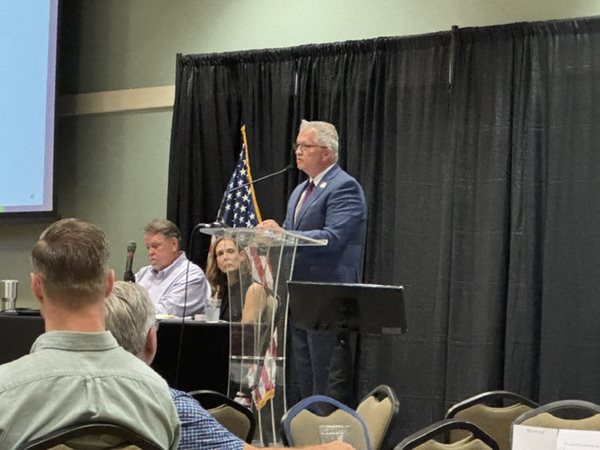
State Senator Danny Carroll helped close out the event. Carroll, along with State Representative Randy Bridges, has crafted the legislation, making nuclear a front-burner issue in Kentucky. The legislation created the Kentucky Nuclear Energy Development Authority, which requires the educational meetings.
KNEDA was established by the Kentucky General Assembly in 2024. The authority serves as a non-regulatory state agency focused on supporting and facilitating energy development, coordinating strategy, and expanding energy education in the state.
KNEDA is administratively attached to the University of Kentucky Center for Applied Energy Research. The Nuclear-Ready Community program was developed to help communities demonstrate their preparedness to support potential nuclear energy-ready development.
Carroll noted that meetings like the two this week were what was envisioned when the legislation was written.
He said, “Those of you who are just adamantly opposed to this, there is nothing I’m going to say that’s going to change your mind. And I respect that. And you have the right to have your opinion. I’m glad you’re being heard.”
He went on to advocate for the continued development and said that the homework has been done at the local, state, and federal levels. Carroll said that he understands the concerns, especially about health, and that those concerns are real. However, he said that was a different time and that safety was not at the forefront. Carroll said that has changed, and so has the technology.
Carroll added, “The world is changing. We can either go with it, and grow and prosper, and build a better community. Or we can get left behind.”
A second public meeting happens from 8 a.m. to 10 a.m. Friday at the Convention Center.